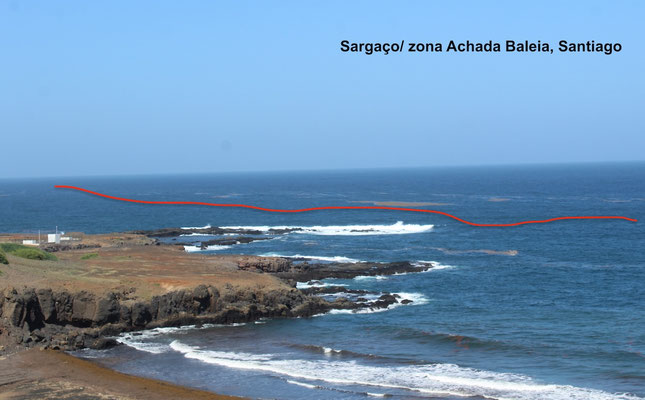
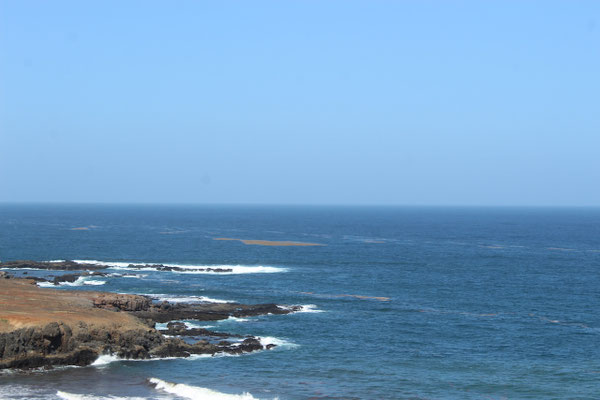
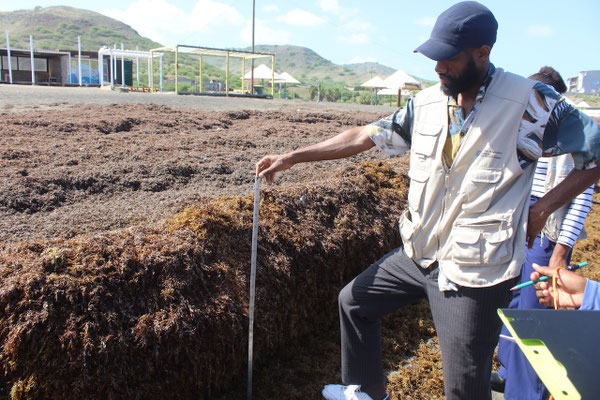
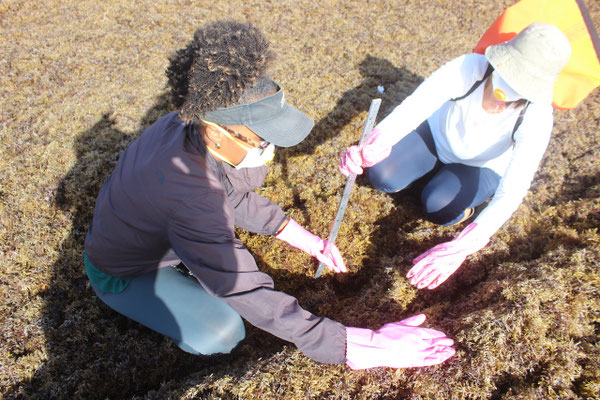
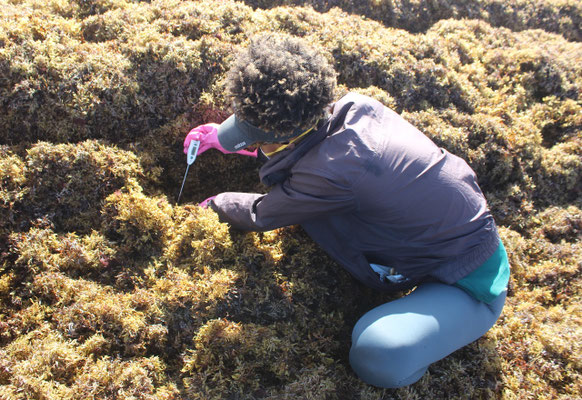
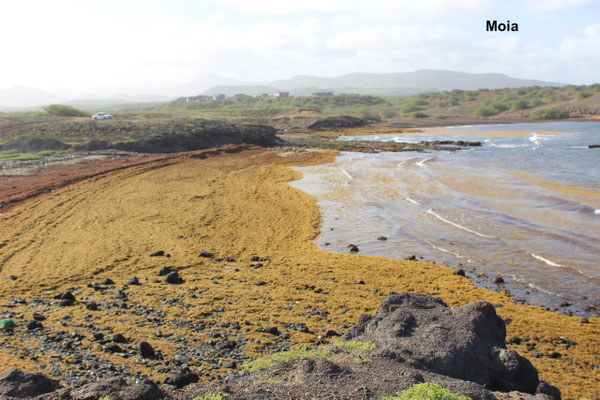
Over the last two weeks southern islands of Cabo Verde, especially Santiago has been experiencing a large inundation of brown algae Sargassum. In some beaches like Moia Moia or Baia the layers of rotting reached up to 95 and 65 cm, with biomass reaching more that 200 tones. Removal in some areas such as Calheta São Miguel and Praia Baixo has already started.
In water FRESH Sargassum is not dangerous or toxic to humans, but care should be taken because of possible accumulation of bacteria on algae or plastic waste.
On the beach, decomposing/ rotting Sargassum can have health impacts due to high levels of gasses and bacteria.
What Sargassum is?
Sargassaceae family currently comprising over 300 species; however, only two – Sargassum fluitans and Sargassum natans – are holopelagic (never attaching to the seafloor) and these dominate the now two large-scale floating domains of the Atlantic, the Sargasso Sea and the Great Atlantic Sargassum Belt. Berry-like, gas-filled bladders (small balls) keep the sargassum afloat while it reproduces asexually, growing anew from mere fragments of itself. These clever adaptations allow vast, free-floating mats to form at the sea’s surface.
Where it comes from to Cabo Verde?
It is still unclear as to how the GREAT ATLANTIC SARGASSUM BELT (#GASB) began. Some scientists indicate that the sargassum from the Sargasso Sea began to escape eastwards as a result of climate change induced shifts in usual wind and current patterns. Add to this some strong upwelling currents off West Africa, optimal water surface temperatures and lower pH values due to ocean acidification (this counterintuitively encourages tissue growth in macroalgae). The GASB presents as many separate island-like masses that can stretch for hundreds of kilometres, inundating some shorelines.
GOOD: Habitat and Shelter: Forms floating mats that provide refuge, breeding grounds, and camouflage for hundreds of species, from juvenile fish to sea turtles. Food Source: Supports marine food webs, feeding fish, crabs, shrimp, and seabirds.Coastal Protection: In small amounts, it helps build and stabilize sand dunes, preventing beach erosion.Resource: could be transformed into biofuels, biofertilizers, animal feed.
BAD: Once in shallow coastal waters, the dense seaweed carpets can smother coral reefs and prevent sunlight from reaching critical seagrass habitats – all bad news for biodiversity and fragile food chains, while also clogging harbours, ensnaring fishing boats and gear,. Washed up on shorelines the dying sargassum releases ‘rotten-egg’ hydrogen sulphide gas, with impacts on local economies alike. Furthermore, the mats of seaweed can accumule plastic debris, pollutants and harmful bacteria. From tourism and fishing industries to human health, the impacts of these unprecedented blooms are serious.
WHAT TO DO?
1. Preparation and adaptation. Annual monitoring during the Sargassum migration period is a must. Communication with agencies responsible. Algorithm of response.
2. If the layer accumulated in the beach is between 25-30 cm it is highly recommended to start removal to reduce the intoxication by gases from decomposing seaweed.
3. Removal should be done 24-72h after the large accumulations have been identified, especially close to human settlements.
4. Manual removal with rakes of the layers up to 30 cm or less is the safest option not ot damage beach substrate.
5. Mechanical removal should be used for faster removal of thick layers especially if seaweed in advanced decomposition.
6. The disposal site should allow the sargassum to spread out and dry (layer up to 10cm) and should not be near sources of drinking water or agricultural fields, as the effluents from the decomposition of sargassum can contain high levels of heavy metals that are harmful to the environment.
7. Hydrogen sulphide and methane meters could be installed around the storage site to monitor air quality.
8. EFFECTIVE COMMUNICATION OF THE PROTECTION MEASURES TO COMMUNITEIS AFFETECD.
In collaboration with the National Directorate of Environment and Municipality of Sao Domingos, communities of Praia Baixo, Moia Moia and Baia.